
AC Repair vs Replacement in Cape Coral, FL
A practical way to weigh one more repair against replacing the system — based on age, failure scope, refrigerant type, repair history and how the house has been performing.
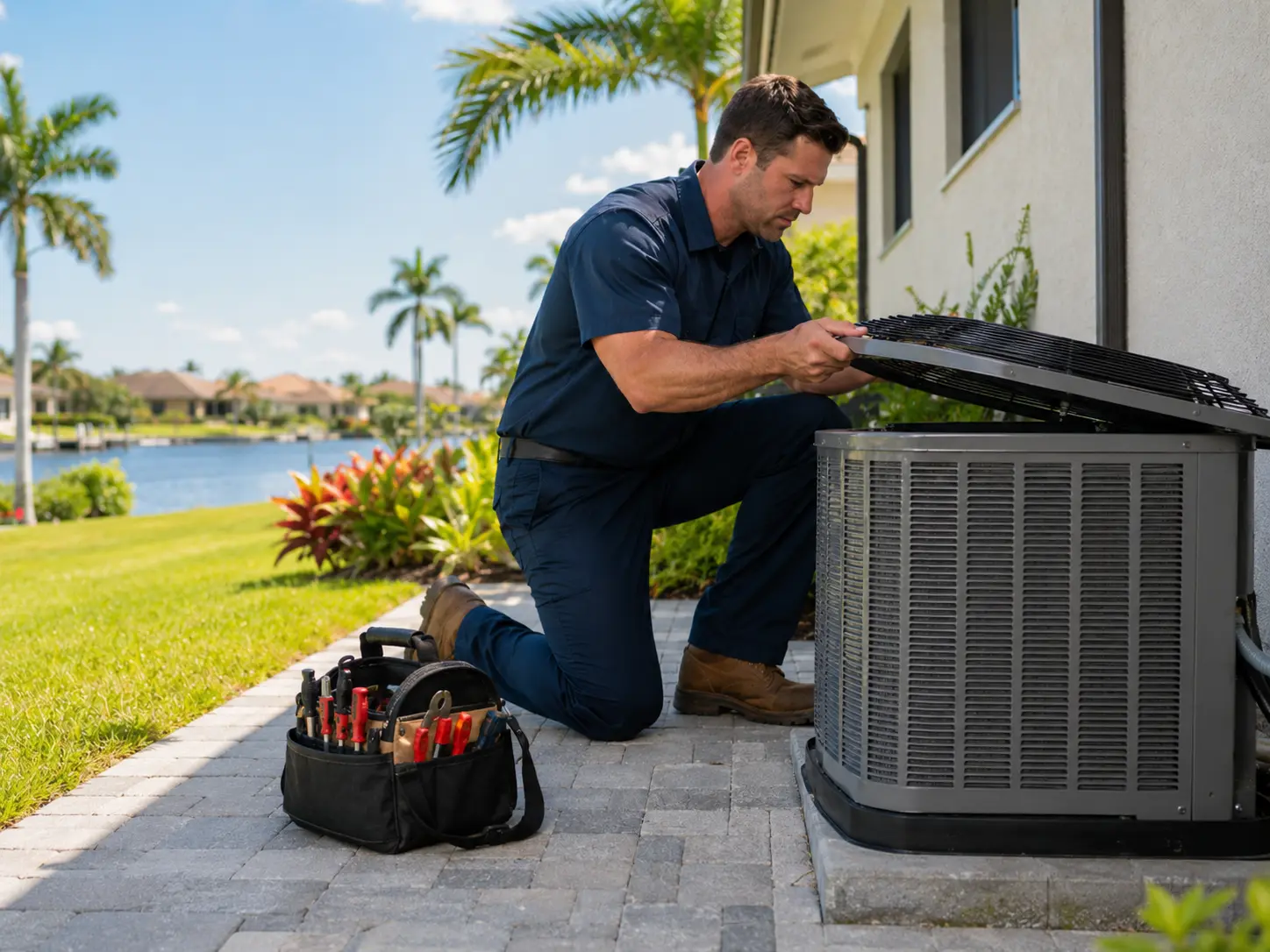
Most air conditioning failures are repairs, and treating every breakdown as a replacement conversation would be misleading. A capacitor, a contactor, a blocked drain line or a failed thermostat are all contained problems on an otherwise healthy system. Replacing equipment because of one of those would waste years of remaining service life.
The decision becomes real under a narrower set of conditions: the equipment is old, the failure is major, or the system has been repaired repeatedly. In Cape Coral those conditions arrive sooner than in cooler regions, because local systems accumulate far more run hours per year and face salt air, storm-related electrical stress and constant condensate load.
Rather than a single rule, it helps to look at five inputs together: age, the scope of the current failure, refrigerant type, repair history, and current comfort performance. Any one of them alone rarely decides it. Two or three pointing the same direction usually does.
Signs that lean toward repair
- The system is under about ten years old and has no significant repair history.
- The failure is a single accessible component: capacitor, contactor, relay, float switch or thermostat.
- Cooling and humidity performance were normal until this failure.
- Parts are current and readily available for the equipment.
- The equipment or compressor still carries manufacturer warranty coverage.
Signs that lean toward replacement
- The system is well past the typical residential service life for this climate.
- The failure involves the compressor or a leaking evaporator or condenser coil.
- This is the second or third significant repair in a short period.
- The system uses an older refrigerant that is expensive or difficult to source.
- The house has struggled with humidity or uneven cooling for several seasons.
System age
Age matters less as a number than as a proxy for what else is likely to fail. A system that has run heavy cooling loads for well over a decade has aged motors, an aged compressor and coils that have been through many thermal cycles. Repairing one component on such a system does not reduce the odds of the next one failing.
Scope of the current failure
Sealed-system work sits at the top of the scale. A compressor failure or a leaking coil involves major parts, refrigerant handling and substantial labour, which is exactly where the comparison against new equipment gets close. A capacitor replacement does not.
Refrigerant type
Older refrigerants are being phased down, and their cost and availability reflect that. If a system needs a significant charge of an older refrigerant after a leak repair, that cost belongs in the comparison — as does the likelihood of needing it again on aging coils.
Repair history
A pattern of repairs tells you more than any single event. Two or three service visits across recent seasons suggests the system is at the stage where components are reaching the end of their lives together, and each repair buys a shorter reprieve than the last.
Comfort and humidity performance
Cooling that keeps up but leaves the house damp, or rooms that never match the thermostat, indicate the system is no longer matched to the house — through capacity loss, duct condition or sizing. Repairing a failed part will not change that, and it is a strong argument for evaluating replacement rather than another repair.
What this page cannot do
No page can tell you whether your specific system is worth repairing. Age and symptoms narrow the question, but the answer depends on measurements taken at the equipment: pressures, electrical readings, coil condition and compressor performance. Use the helper below to organise the inputs, then call 239-977-3257 to discuss them.
Repair or Replace Decision Helper
This tool is informational and does not replace an in-person system evaluation.
Related reading
Describe your AC problem and get help lined up
Call to talk through the symptoms and check current service availability, or send the details through the service request form.