
Common AC Problems in Cape Coral, FL
Start from the symptom. Each section explains what it usually indicates and which service page covers the repair.
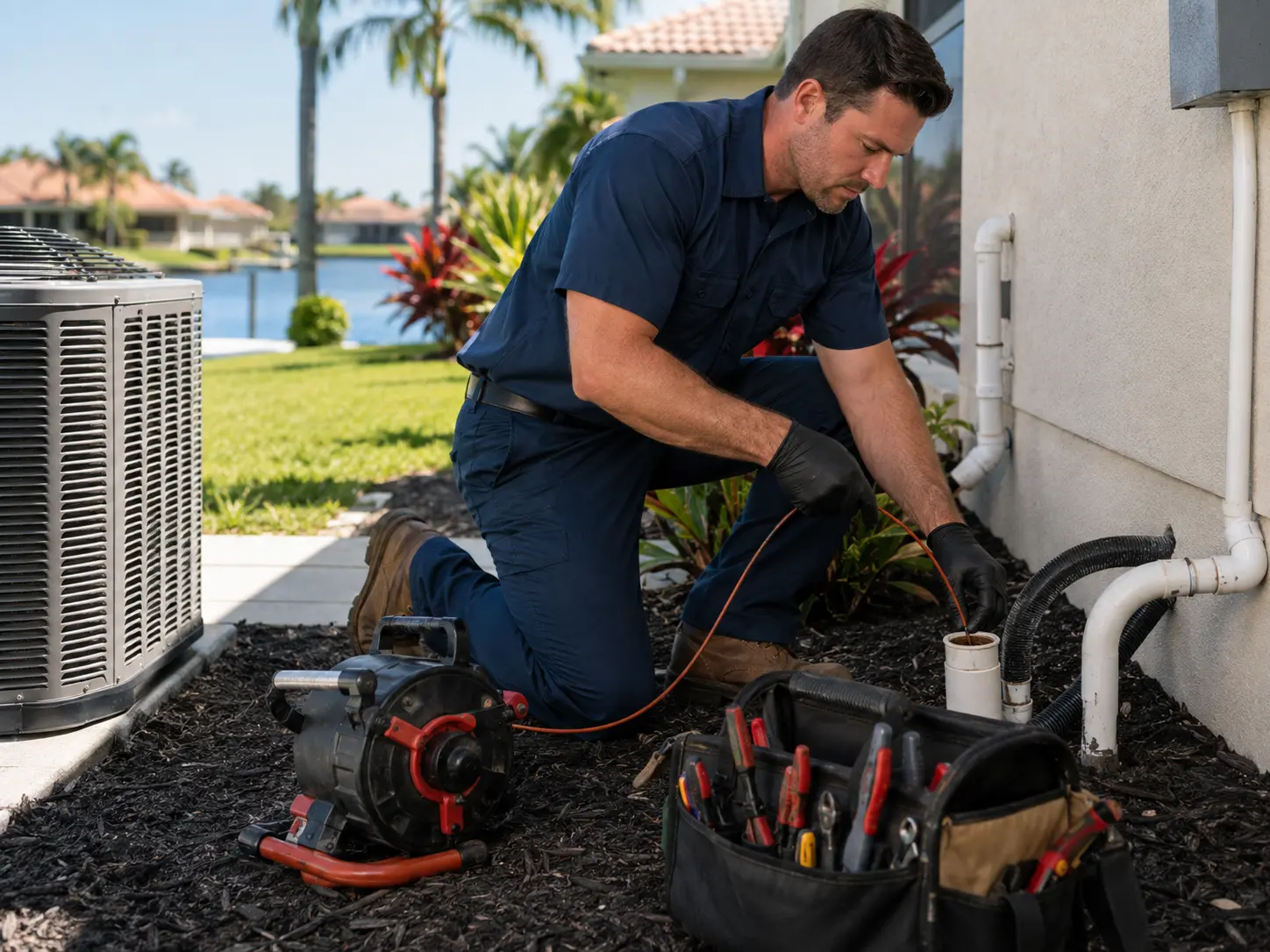
Cooling problems tend to announce themselves through one of a dozen symptoms. Each of those symptoms points at a system area — air side, refrigeration circuit, electrical side or drainage — and knowing which area is involved is most of the work.
The guide below covers the symptoms Cape Coral homeowners commonly deal with. Where a symptom has two very different possible causes, that is stated plainly instead of guessing at one, because the difference usually decides how involved the repair is.
AC not cooling
The system runs, air moves at the vents, but indoor temperature stays above the setting. This is the most common complaint and the least specific, because it can come from airflow, refrigerant charge, compressor performance or a fouled outdoor coil.
Diagnosis works by measurement: temperature split across the indoor coil, operating pressures, airflow and electrical readings. Those numbers separate a system that cannot move enough air from one that cannot move enough heat.
AC blowing warm air
Air that feels close to room temperature usually means the refrigeration circuit is not doing its job. A tripped outdoor unit, a failed capacitor, a refrigerant leak or a compressor that is not pumping all produce this symptom.
Check whether the outdoor unit is running at all. If the indoor blower runs while the condenser sits still, the problem is likely electrical or control related rather than airflow.
AC won't turn on
Nothing responds to a cooling call. Causes range from a blank thermostat and a blown low-voltage fuse to a tripped breaker, a failed contactor or a condensate float switch that has interrupted the circuit.
If a breaker has tripped more than once, leave it off. Repeated trips indicate a fault that needs identifying rather than resetting.
AC freezing or icing up
Ice on the indoor coil or the copper line set means the coil is running below freezing. Reduced airflow and low refrigerant are the two root causes, and they lead to entirely different repairs.
Switch cooling off and run the fan so the coil can thaw. Running a frozen system risks liquid refrigerant returning to the compressor.
AC leaking water
Water near the air handler, staining on a ceiling below an attic unit, or a full drain pan almost always points to condensate drainage. In humid Cape Coral conditions a system removes a large volume of water every day, and a partly blocked line backs up quickly.
Many systems have a float switch that shuts cooling down before an overflow. A system that stops and later restarts on its own is often doing exactly that.
AC short cycling
Cycles that last only a few minutes prevent the system from reaching steady operation, which hurts both efficiency and moisture removal. Thermostat placement, control settings, safety devices, airflow restriction and refrigerant problems can all cause it.
Short cycling also increases starting current events, which accelerates wear on capacitors, contactors and compressor windings.
AC making unusual noise
Noise is a useful clue because different sounds implicate different parts. Screeching or grinding suggests bearings; a loud buzz can be electrical; clicking on start-up can indicate a relay or hard-start condition; a metallic rattle may be debris in the condenser.
Loud mechanical noise from the compressor at start-up deserves prompt attention, since continued operation can worsen internal damage.
AC running constantly
During Cape Coral summer afternoons, long run times are normal. Continuous operation that never satisfies the thermostat is not, and usually indicates lost capacity: a dirty coil, low refrigerant, a weak compressor or a system undersized for current load.
Comparing behaviour with previous seasons helps. A system that used to cycle and now runs continuously has lost something measurable.
Weak airflow from vents
If registers deliver little air, the air side needs attention: loaded filters, a dirty blower wheel, a failing motor, closed or blocked registers, or duct leakage and collapse in the attic.
Weak airflow also drives coil temperature down, which is why airflow problems so often end as frozen coils.
Thermostat problems
Blank displays, readings that disagree with a separate thermometer, schedules that do not take effect and smart thermostats that lose connection all interfere with cooling even when the equipment is healthy.
Some smart thermostats require a common wire or specific staging support. Installations that skip that produce intermittent, hard-to-repeat behaviour.
High indoor humidity
A house can hit its temperature setting and still feel clammy. Moisture removal depends on run time, airflow and coil temperature, so short cycles, oversized equipment or restricted airflow all leave humidity behind.
In Southwest Florida this is a common complaint, and it is worth treating as a real symptom rather than a preference issue.
Uneven cooling between rooms
Rooms that never match the rest of the house usually reflect distribution rather than equipment: long duct runs, leakage in hot attic space, register balance or heavy solar gain through west-facing glass.
Measuring airflow at the registers shows whether a room is being served properly before anything is changed at the equipment.
When to stop the system and call
Switch cooling off and call 239-977-3257 if the coil is iced, water is reaching finishes, a breaker has tripped repeatedly, or there is a burning smell. Continuing to run a system in those conditions can turn a contained repair into a larger one.
For anything urgent, the emergency AC repair page explains what to do while you wait, and current availability is confirmed by phone.
Describe your AC problem and get help lined up
Call to talk through the symptoms and check current service availability, or send the details through the service request form.