
AC Refrigerant Leak Repair in Cape Coral, FL
Leak investigation, repair options and charge correction for systems losing cooling capacity over time.
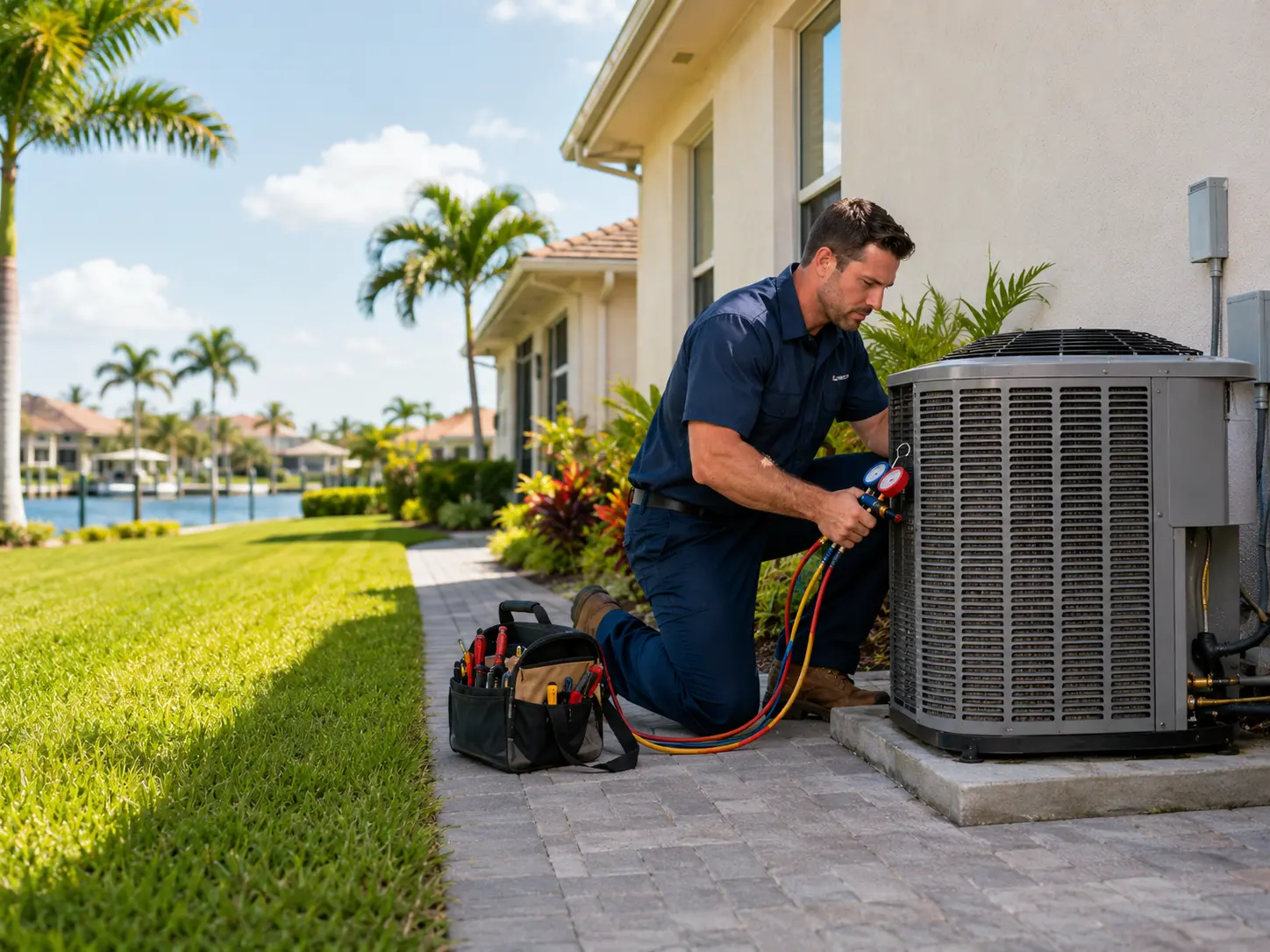
Refrigerant circulates in a sealed system and is not used up during normal operation. When a system is low, refrigerant has escaped somewhere, and topping off the charge without finding that point returns the same symptoms later.
Leaks develop at coil tubing, brazed joints, service valves, line-set connections and points where vibration or corrosion has worn metal thin. Some are large enough to cause a rapid loss of cooling; others release slowly over seasons.
This page covers the symptoms that suggest a leak, how leaks are located, and the practical repair decisions that follow once one is found.
Symptoms and warning signs
- Cooling capacity that has weakened gradually over months
- Ice forming on the indoor coil or on the suction line
- Longer run times with less temperature drop across the coil
- A hissing or bubbling sound near the indoor unit or line set
- Oily residue at fittings, joints or on the coil
- The system cools acceptably in mild weather but falls behind in heat
- A previous refrigerant top-up that only helped for a season
- Higher electricity use with no change in habits
Possible causes
Coil corrosion
Thin-wall aluminium and copper coil tubing can develop pinhole leaks, sometimes accelerated by indoor air chemistry or by coastal and salt-influenced outdoor air.
Vibration fatigue
Years of compressor vibration work on brazed joints and tubing supports. Fatigue cracks at these points are a common leak source on older equipment.
Service valve and fitting leaks
Schrader cores, caps and flare or brazed connections can seep slowly. These are among the easier leaks to address once located.
Line-set damage
Physical damage during landscaping, pressure washing, or wear where a line passes through a wall or slab penetration can create a leak point outside the equipment itself.
Poor original brazing
A joint that was never fully sealed can leak slowly from installation onward, which sometimes explains a system that has always seemed to need charge.
Component failures
Failed evaporator or condenser coil sections, filter driers and metering devices can leak or contribute to conditions that stress joints elsewhere.
What a diagnostic visit may involve
- Confirmation that symptoms match a charge problem rather than airflow alone
- Pressure and temperature readings taken to evaluate charge and superheat conditions
- Visual inspection for oil traces at coils, joints and fittings
- Electronic leak detection, bubble solution or dye methods used as appropriate
- Coil and line-set accessibility assessed if a repair is possible
- Explanation of what was found, where, and which repair paths exist
- Evacuation and correct weighed-in charge when a repair is completed
Repair considerations
- Not every leak is worth repairing. A leaking joint or valve is often a practical fix; a leaking evaporator coil on aging equipment introduces a larger cost decision, especially if the system uses a refrigerant that is being phased down.
- Adding refrigerant without repair is sometimes chosen as a short-term measure, but it should be described as exactly that. Repeated top-ups add cost without solving the fault.
- If a coil replacement is on the table, the comparison against full system replacement matters, because coil, charge and labour together can approach a meaningful fraction of new equipment cost.
Why this matters in Cape Coral
Salt-influenced air along Cape Coral's canals and coastal areas can contribute to corrosion on outdoor coils and line-set components over time, and irrigation spray directed at a condenser adds to that exposure.
Because Southwest Florida systems run long hours, a slow leak that might go unnoticed in a mild climate usually reveals itself here as steadily weaker cooling during peak heat.
Related AC issues and services
See every option on the AC services hub or contact us with your details.
Service areas
This service covers Cape Coral, including Pelican, Cape Harbour, Yacht Club. View all service areas.
Frequently asked questions
Does my AC need refrigerant every few years?
Can a refrigerant leak be sealed permanently?
Is a refrigerant leak dangerous at home?
Why does ice form when refrigerant is low?
How is the correct charge determined after a repair?
Describe your AC problem and get help lined up
Call to talk through the symptoms and check current service availability, or send the details through the service request form.